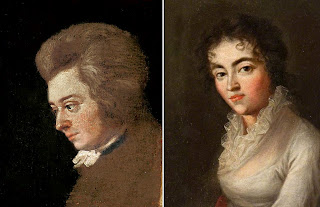
On 4 August 1782 Mozart married Constanze Weber, despite serious opposition to the union from his father. On 3 April 1783 Mozart wrote to his father Leopold:
"The two portraits will follow; – I only wish that you will be pleased with them. I think they are both good likenesses and all who have seen them are of the same opinion."
[The portraits of Mozart and his new wife Constanze, which Mozart likely sent to his father in the spring of 1783. They were painted by Joseph Lange, the husband of Constanze's sister Aloysia, in late 1782 or early 1783. Both portraits were later expanded, though the Mozart expanded version was never finished.]
On 17 June 1783 the Mozarts' first child Raimund Leopold was born. Mozart wrote to this father:
“Congratulations, you are a grandpapa! Yesterday, the 17th, in the morning at 6:30 my dear wife successfully gave birth to a large, strong and round-as-a-ball baby boy.”
On 21 June 1783 Mozart wrote:
“The child is quite cheerful and healthy, and has a dreadful amount of business, which consists of drinking, sleeping, crying, peeing, pooping, dribbling, etc.”
On 5 July 1783 Mozart wrote to his father:
“Raimundl looks so much like me that all people say the same; it is as if he were cut from my face, which gives my dear wife the greatest pleasure, since this is what she had always wished. Next Tuesday he will be three weeks old, and he has grown a surprising amount"
Following pressure from Mozart's father (who had yet to meet Constanze) the Mozarts travelled from Vienna to Salzburg at the end of July 1783, leaving their precious baby in the charge of a foster-nurse.
Earlier, in a letter to his father written on 4 January 1783, Mozart had mentioned a promise to write a mass to be performed on the first visit the newly weds would make to Salzburg. Constanze gave more specific details of this promise when she met Vincent Novello during his visit to Mozart's widow in 1829. Apparently, Mozart initially intended the work to be a votive mass for the safe delivery of their first baby. Novello carefully recorded Constanze's description in his diary:
"The 'Davidde penitente', [K.469] originally a grand Mass [K.427] which he wrote in consequence of a vow that he had made to do so, on her safe recovery after the birth of their first child — relative to whom he had been particularly anxious. This Mass was performed in the Cathedral at Salzburg and Madame Mozart herself sang all the principal solos. Mozart thought so highly of this production that he afterwards made several additions and adapted new words to make it a complete Cantata, or rather Oratorio, for the former is too modest a title for so elevated, elaborate and masterly a work."
The writing of the original Mass came to an abrupt end in 1783, and the reason for this is obvious. While in Salzburg Wolfgang and Constanze would have received the tragic news from Vienna that their baby Raimund had died on 19 August 1783, at the age of just 2 months. Correspondence from this period is missing or non-existent, but a few months later, on 10 December 1783, there is a note from Mozart, now back in Vienna, to his father in Salzburg, in which he writes: “Regarding our poor, big, fat, dear little boy we are both really suffering.”
On the eve of their return to Vienna, at the conclusion of their fated Salzburg visit, the grieving Wolfgang and Constanze took part in the long promised performance of the incomplete Mass in C minor K.427, on 26 October 1783 at Salzburg's St Peter's Abbey. It must have taken Constanze all the strength she had to sing this music in such circumstances, music written so specifially for the safe delivery of their first child, including the heart-breakingly beautiful aria Et incarnatus est. A finer work of art inspired by love could not be conceived. Mozart's devotion to his wife fills his correspondence to her. In July 1791, when Constanze was ill during her sixth pregnancy and on a rest cure in Baden, Mozart wrote to her from Vienna: "you cannot imagine how slowly time goes when you are not with me. There is a sense of emptiness, which hurts, a certain longing which cannot be satisfied. When I remember how childishly merry we were in Baden [in June 1791 Mozart visited Constanze in Baden, and while there wrote his Ave Verum Corpus], and what mournful, tedious hours I pass here, my work gives me no pleasure because it is not possible as was my want to chat a few words with you when stopping for a moment. If I go to the clavier and sing something from the opera [the Magic Flute, on which he was working] I must stop at once because of my emotions". Ten years earlier, in December 1781, writing to his father, Mozart justified his reasons for wanting to marry Constanze in the simplest terms: "She has the kindest heart in the world. I love her and she loves me with all her heart."
On 24 August 1788, six years into their marriage, the Mozarts were visited by the Danish musician Joachim Daniel Preisler, who wrote afterwards:
"There I had the happiest hour of music that has ever fallen to my lot. This small man and great master twice extemporized on a pedal pianoforte, so wonderfully! so wonderfully! that I quite lost myself. He intertwined the most difficult passages with the most lovely themes. His wife cut quillpens for the copyist, a pupil composed, a little boy aged four [presumably the Mozarts' son Carl Thomas] walked about in the garden and sang recitatives — in short, everything that surrounded this splendid man was musical!"
The video below features the wonderful American soprano Arleen Augér singing the Et incarnatus est Mozart specifically wrote for his wife Constanze to sing as part of the C minor Mass. Arleen Augér was an incomparable interpreter of Mozart who enjoyed a brilliant career in Europe, though her home country of the United States was slow to wake up to her remarkable talent. In this beautiful live performance (filmed in Germany in 1990 under the direction of Humphrey Burton) Augér's singing is so sublime it actually moves her conductor, Leonard Bernstein, to tears after her last note is sung. The video is particularly poignant for other reasons too: a year after this performance Arleen Augér developed the symptoms of a brain tumour to which she eventually succumbed in 1993, dying at the age of just 53 [1993 was a sad year for sopranos as we also lost the wonderful Lucia Popp, also from a brain tumour, and at almost the same age as Augér]. This video is also a recording of one of Leonard Bernstein's last performances, the conductor and composer dying 6 months later, in October 1990, at the age of 72. Above all, it's a sobering thought to think that the creator of this sublime music died before even reaching his 36th birthday. If there's a lesson here it's that we should cherish every moment, and celebrate the fact that all these remarkable people live on in our hearts long after they no longer walk on this earth.
[Mozart's Et incarnatus est from the Credo of his Mass In C Minor, K.427, sung by Arleen Auger (soprano) with the Bavarian Radio Symphony Orchestra conducted by Leonard Bernstein, recorded live at the Abbey Church of Waldsassen, Germany, in April 1990.]
[Ivory miniature of Wolfgang Amadeus Mozart and his older sister Maria Anna Mozart (Nannerl) by Eusebius Johann Alphen c.1765]
It's a fascinating and mouthwatering glimpse into the past reading about Vincent and Mary Novello's visit to Salzburg in 1829, twenty-eight years after Mozart's death, to visit two people intimately connected with their musical idol: Mozart's sister, Nannerl, and Mozart's widow, Constanze. The sensation of reading Vincent Novello's diary feels strangely contemporary, as if their Mozart quest could have taken place just yesterday. In truth the Novellos are barely any closer to our age than the Mozarts were, yet it doesn't stop me boggling at the thought that Vincent and Mary Novello were meeting the two most important women in Mozart's life as late as the dawning era of Chopin and Liszt and so called romanticism! It's a sad reflection on the paucity of our own artistic age that so much remarkable creativity took place within such a short time span: barely 50 years is needed to cover the period from mature Mozart, through all significant Beethoven, the entire lives of Schubert and Chopin, to the dawning era of Brahms. In today's age that same time span would only take us as far back as 1970. Perhaps I'm also fascinated by the Novellos' idol-seeking quest because I've done similar things myself: in 1992 I travelled from London to New York for the sole purpose of meeting Gershwin's sister Frankie and Gershwin's girlfriend Kay Swift, as part of my own hero worship of Gershwin (who like Mozart also died tragically young) and my search for anyone with a close connection to the composer.
But the Novellos only just made their trip in time. Mozart's sister, Nannerl, now 77, was dangerously ill and close to death. Since 1819 Nannerl and Mozart's widow Constanze had been close neighbours, though their relationship in the past had been quite strained. Constanze and her second husband Georg Nikolaus von Nissen had moved to Salzburg from Copenhagen to facilitate the writing of the first authoritative biography of Mozart. Sadly Nissen died before the project could be completed, but the biography was eventually published, under Constanze's watchful eye, a year before the Novellos' 1829 visit.
Coincidentally, at the exact same time as the Novellos' visit to Salzburg, Chopin was making his way to Vienna, his first ever visit to the city. Two weeks after his arrival at the end of the July, he made his Vienna debut, on 11 August 1829 at the Royal and Imperial Opera House. Before returning to the Novellos' Mozart quest I think it's interesting to briefly pause for this contemporaneous event in nearby Vienna. Chopin has left us a detailed account of the trials leading up to his Viennese debut in this letter to his close friend Titus Woyciechowski:
"The orchestra kept scowling at me during rehearsal, the main cause being that, having scarcely arrived, I had the nerve to play my own compositions. Well, I began the rehearsal with your Variations which were to be preceded at the concert by the Krakowiak Rondo. They went well, but I had to begin the Rondo a couple of times and the orchestra got frightfully mixed up and blamed my bad writing. The cause of the confusion was that the rests were written differently above and below the stave, but it was agreed that only the top ones should count. It was partly my fault, but I had expected that they would understand. All the same this inaccuracy infuriated them, for these gentlemen are themselves virtuosi and composers. Anyhow they made such cutting remarks about me that I felt almost like falling ill in preparation for the evening's performance. However, Baron Demmar, the director, noticing this little prejudice on the orchestra's part (by the way, Würfel insisted on conducting and they don't like him — I don't know why) proposed that instead of the Rondo I should improvise. When he said THAT, the orchestra opened their eyes very wide. I was so worked up that in despair I accepted, and who knows but what my bad temper and the risk I was running did not spur me on to a better performance in the evening. Anyway, the sight of the Viennese public did not put me out in the least, and as it is the custom for the orchestra to stay in their usual places [down below] instead of being on the stage, I sat down, pale, with a young man wearing rouge to turn over the pages (he boasted that he had done the same for Moscheles, Hummel, Herz, etc., when they were in Vienna), in front of a superb instrument, perhaps the finest then in Vienna, made by Graff. Believe me, I played out of sheer desperation. The Variations produced such an effect that although they applauded after each one I had to come out and take another bow at the end. In between, Mlle Veltheim sang; she is Kammersängerin to the King of Saxony. At last the moment came for me to improvise. I don't know how it all happened, but it went so well that the orchestra began to clap and I was again called back to the stage. So ended my first concert." [Chopin, letter to Titus Woyciechowski, Vienna, 12 September 1829]
The Novellos visited Vienna as well as Salzburg during their Mozart pilgrimage in that summer of 1829, but sadly I haven't come across any record of them hearing the 19-year-old Chopin. And how sad to think that Mozart's widow and sister could potentially have heard Chopin that night. Mozart's sister would have been too infirm to make the almost 200 mile journey, but Constanze could have been up for it, and after all, she knew Vienna well, home to her and her sisters Aloysia and Sophie before and after she married Mozart. All three sisters were now widowed, and all three were now living close to one another in Salzburg. Had they even been aware of Chopin, and attended his Vienna debut, one work on the programme, which Chopin was premiering that very night, would have sounded very familiar to them: his Variations on Là ci darem la mano from Mozart's Don Giovanni!
[Pencil drawing of (1829), by Princess Elisa Radziwiłł]
Meanwhile, back in Salzburg, the Novellos were charmed by Constanze Mozart Nissen, who always referred to her first husband as "her Mozart" and "her one true love". She told the Novellos that one particular portrait she had on display (by Joseph Lange) was the best likeness of her husband.
[Unfinished portrait of Mozart at the piano (1789), by Joseph Lange]
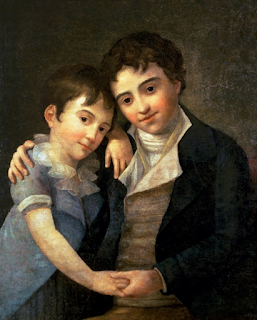
The Novellos also remarked on the touching portrait of the Mozart children, Karl Thomas and Franz Xaver, hand in hand. Mozart had proudly taken his 7-year-old son Karl Thomas with him to the first performances of The Magic Flute in 1791 ("My taking Carl to the opera caused him no small joy" Mozart wrote to Constanze on 14 October 1791). Franz Xaver was only a 5 month old baby when Mozart died so sadly would have had no memories of his father.
[Portrait of the two surviving children of Wolfgang and Constanze Mozart, Franz Xaver and Karl Thomas (1798), by Hans Hansen]
Constanze also shared other intimate details of the Mozarts' homelife with the Novellos. She told them that Mozart was always composing, irrespective of place or circumstances. She told them that his Quartet in D minor K.421 was written when she was at the height of labour, giving birth to their first child Raimund Leopold (who tragically died 2 months later). Constanze said that the baby's unrest and her own cries can be heard in several passages of the music, particularly in the minuet [its trio]. Constanze even sang some of the passages to the Novellos to demonstrate!
[Minuet & trio from Mozart's Quartet in D minor K.421, played by the Alban Berg Quartett]
For the Novellos in 1829 it must have felt that they were so close, yet still tantalisingly distant, from their musical hero. Vincent Novello kept an autograph album and on his travels in 1829 invited Mozart's widow to sign it, which she happily did with the following inscription:
La misère des pauvres, le bonheur des riches,
La gloire des héros, la Majesté des Rois—
Tout finit par: Ci-gît
Salzburg ce 15 Juillet 1829
Souvenez vous Monsieur et Madame de votre très humble Servante Constance de Nissen Veuve Mozart
Constanze also presented the Novellos with a number of gifts, including a sample of Mozart's handwriting cut from an envelope Mozart had addressed to his father, and some manuscript fragments including Mozart's keyboard reduction of two of his minuets from K.176.
[Minuet no.3 in E flat K.176 performed by the Vienna Mozart Ensemble conducted by Willi Boskovsky, preceded by the composer's own reduction for keyboard, played by Martino Tirimo. The featured manuscript is Mozart's autograph, which his widow Constanze gave as a gift to Vincent Novello during his visit to Salzburg in 1829]
Constanze also presented Vincent Novello with a copy of the aria Al desio di chi t'adora, written as a replacement for Deh vieni non tardar for the August 1789 revival of The Marriage of Figaro. Mozart is said to have used this copy to accompanying his wife, and on the last page, under a vocal cadenza, Constanze has written the words:
"Questa e la Scritura di mio defonto Marito Mozart chi ha fato per me e che il signor Novello aver la bonagrazie de prendere da mie, Constanze Nissen, Salisburgo il 3 Augusto 1829"
"This is the writing of my deceased husband Mozart who created it for me and which Signor Novello has the good grace to take from me, Constanze Nissen, Salzburg, 3 August 1829"
[The last page of Al desio di chi t'adora from the 1789 revival of The Marriage of Figaro, with an inscription by Mozart's wife, Constanze Nissen, under a cadenza written in Mozart's own hand]
[Detail of Constanze's inscription to Vincent Novello on the last page of Mozart's aria Al desio di chi t'adora, pointing out the cadenza in Mozart's own hand]
Mozart had previously written many arias for his wife's high soprano voice including, most notably, the Et incarnatus est from his C minor Mass K.427 of 1783. You can hear the complete Al desio di chi t'adora aria from The Marriage of Figaro here:
[Al desio di chi t'adora from the 1789 revival of Mozart's The Marriage of Figaro, sung by Cecilia Bartoli, with the Wiener Kammerorchester conducted by György Fischer]
Constanze not only had an influence on her husband's vocal writing but also played an important rôle in encouraging his interest in polyphony, according to the words of Mozart himself:
"I composed the fugue [of the Fantasy and Fugue, K. 394] first and wrote it down while I was thinking out the prelude. I only hope that you will be able to read it, for it is written so very small; and I hope further that you will like it. Another time I shall send you something better for the clavier. My dear Constanze is really the cause of this fugue's coming into the world. Baron van Swieten, to whom I go every Sunday, gave me all the works of Händel and Sebastian Bach to take home with me (after I had played them to him). When Constanze heard the fugues, she absolutely fell in love with them. Now she will listen to nothing but fugues, and particularly (in this kind of composition) the works of Händel and Bach. Well, as she has often heard me play fugues out of my head, she asked me if I had ever written any down, and when I said I had not, she scolded me roundly for not recording some of my compositions in this most artistically beautiful of all musical forms and never ceased to entreat me until I wrote down a fugue for her." [Mozart, letter to his sister Nannerl, 20 April 1782]
When the Novellos arrived in Salzburg in July 1829 they also had with them a gift they wished to deliver to Mozart's sister, a sum of money (£63) raised from well-wishers in England for relief from poverty (in actual fact Mozart's sister was not as destitute as people thought, but the gesture was gratefully received nevertheless). It's worth quoting Vincent Novello's diary at length as he paints such a vivid portrait of his visit to both Mozart's sister and widow. His descriptions of Mozart's sister are very poignant, as she was clearly very close to death (she died just three months after the Novellos' visit, on 29 October 1829):
"Monday, July 15th. — A still more delightful day, if possible, than yesterday — Mozart's son [the Mozarts' youngest son Franz Xaver] came to me at about 11 to conduct us to his aunt Sonnenberg [Mozart's sister Nannerl] — after a little chat we accompanied him to her house, which was within a few yards of where we resided. It seems that she had passed a very restless and sleepless night for fear we would not come to see her, and had repeatedly expressed her regret that we had not been admitted when we first called. On entering the room, the sister of Mozart was reclining placidly in bed — but blind, feeble, and nearly speechless. Her nephew kindly explained to her who we were, and she seemed to derive much gratification from the intelligence we conveyed to her. During the whole time, I held her poor thin hand in mine, and pressed it with the sincere cordiality of an old friend of her brother. She appeared particularly pleased that the little present we had brought her should have arrived on her own Saint's day (St. Ann, the 26th of the month). Her own birthday is on the 30th, on which day she will have completed her 78th year. Her voice is nearly extinct, and she appears to be fast approaching 'that bourn from whence no traveller returns'. Her face, though much changed by illness and drawn by age, still bears a strong resemblance to the portraits that have been engraved of her; but it was difficult to believe that the helpless and languid figure which was extended before us was formerly the little girl represented as standing by the side of her brother, and singing to his accompaniment. Near the bed was the original painting of which Madame Nissen [Constanze, Mozart's widow] has a small copy, and which has been engraved in the Biography, representing Mozart and his sister playing a duet on the piano, the likeness of Mozart's mother in a frame, and the father leaning on the piano with a violin in his hand" [Johann Nepomuk della Croce's Mozart family portrait, c.1780].
[Mozart family portrait: Maria Anna ("Nannerl"), Wolfgang, Anna Maria (wall portrait, already deceased when the portrait was painted) and Leopold Mozart (c.1780) by Johann Nepomuk della Croce]
"In the adjoining apartment, over the sofa was the print which his son told me was generally considered the best likeness after that in Madame Nissen's possession (in which opinion he himself coincided). Around the room was hung a very numerous collection of portraits of the greatest painters, amongst whom I particularly noticed those of van Dyck and Rembrandt. In another part of the room was a miniature of herself; another of her son (who had some resemblance to Leigh Hunt); and another likeness in miniature of Mozart. In the middle of the room stood the instrument on which she had often played duets with her brother. It was a kind of clavichord — with black keys for the naturals and white ones for the sharps, like our old English Cathedral organs — the compass was from F1 to F6, and had evidently been constructed before the additional keys were invented. The tone was soft, and some of the bass notes, especially those of the lowest octave C3 to C2 were of a good quality; at the time it was made it was doubtless considered an excellent instrument. You may be sure that I touched the keys which had been pressed by Mozart's fingers, with great interest. Mozart's son also played a few chords upon it with evident pleasure; the key he chose was that of C minor; and what he did, though short, was quite sufficient to show the accomplished musician. On the desk were two pieces of music, the last which Mozart's sister had ever played, before she took to her bed, six months ago. They were the 'O cara Armonia' from her brother's opera of the Zauberflöte ["Das klinget so herrlich" from the Magic Flute], and the Minuet in his Don Giovanni [from the finale of Act I]; — this, to me, was a most touching proof of her continued sisterly attachment to him to the last, and of her tasteful partiality for his inimitable productions. About two days before we arrived she had desired to be carried from her bed, and placed at the instrument. On trying to play she found that although she could still execute a few passages with her right hand, yet with her left hand she could no longer press down the keys, and it was but too evident that her powers on that side were entirely gone. On leaving this estimable and interesting lady, both Mary and myself could not refrain from kissing her weak and emaciated hand with tender respect, convinced as we were that we should never again behold her. I fear that she cannot continue much longer in her present exhausted state; but whenever that hour arrives which no one living can ultimately avoid, I can only hope that it will not be attended with the least suffering, and that she will calmly cease to breathe as if she were merely sinking into a tranquil sleep. I was particularly charmed by the respectful and kind cordiality with which Mozart's son behaved to her; calling her repeatedly "Meine leibe Tante," and exerting himself to the utmost to ascertain and fulfil all her wishes."
In a subsequent undated entry from the same July 1829 diary Vincent Novello also says more about Constanze:
"After supper I had the gratification of seeing Mozart's widow and her sister safe home. They had brought their servant with them, to save my doing so, and would fain have persuaded me there was not the least necessity for my accompanying them home; but (as I told her) it was not every evening that I could enjoy the society of so rare a companion as one who had been the companion of Mozart, and she politely gave up the little friendly contest, and at once took my arm as cordially as if I had been her own brother. There was a beautiful moon shining on the distant mountains, and illuminating both the old Gothic church of the convent and the ancient fortress above. The interesting conversation which took place, and the enchanting beauty of the surrounding scenery, rendered this one of the most romantic and delightful walks I ever enjoyed. On our arrival at the house I was at last obliged to take my leave; when Madame Mozart once more shook hands with me most cordially, and assured me (after renewing her promise to write to me) that our visit altogether to Salzburg had been one of the most gratifying compliments which had been paid for several years both to herself and to the memory of "her Mozart". I need not say what a crowd of interesting associations, curious thoughts, and singular reflections, passed through my mind in the course of my solitary walk back to my Inn."
[Mozart's O cara Armonia ("Das klinget so herrlich") from The Magic Flute & Minuet from Don Giovanni (from the finale of Act I), the last two pieces of music Mozart's sister Nannerl ever played]
[Portrait of Constanze Mozart (1802) by Hans Hansen. Hansen met his future wife, Jørgine Henriette Liewhile, while painting this portrait, and when their first child was born they named him Constantin in honour of Constanze, who became the boy's godparent (Constantin, like his father, became a well-known Danish painter).]
"Practice, practice, practice" comes the answer, in this well-known old joke. In the light of my own recent experience this adage needs to be amended. When I first played at Carnegie Hall many years ago I was proudly shown a letter by the hall administration from Gershwin, thanking Carnegie Hall for their help. Carnegie Hall had witnessed the premiere of An American in Paris in 1928 and in September 1935 Carnegie Hall was the location chosen for a private rehearsal of his opera Porgy and Bess, the first full orchestral run-through without cuts. Prior to its Boston and New York premieres this was the very first time the opera had ever been heard in its entirety, and aside from the performers the only others present in the vast auditorium were a few friends and family. Ira Gershwin described the occasion thus: "Until then only George knew what it would sound like. I couldn't believe my ears. That wonderful orchestra and the full chorus on the stage. I never realized it would be like that. It was one of the great thrills of my life". Ann Brown, who sang Bess in the opening production, has also left us an evocative description of that first Carnegie Hall run-through: "When the echoes of the last chords of Porgy and Bess had disappeared into the nearly empty hall, we were – all of us – in tears. It had been so moving."
In the late spring of 2019 I was deeply honored to be asked to play again at Carnegie Hall in the autumn of 2019 for an event that was described to me as celebrating 100 years of diplomatic relations between Poland and America (with in attendance a sea of specially invited guests from embassies, consulates, the UN and so forth). I had been asked to contribute the music of two composers who are central to my repertoire, Chopin and Gershwin, ending the evening with the latter’s Rhapsody in Blue. In addition I would be working with the soprano Angel Blue in extracts from Porgy and Bess (Angel Blue was about to open in the lead role of the New York Metropolitan Opera's first production of Porgy and Bess in 30 years). Also invited to take part was the Canadian pianist Charles Richard-Hamelin, and other distinguished artists, and in addition I would be working with soloists from the Polish National Ballet on a specially devised choreography of my own authentic Gershwin repertoire. It sounded like a dream concert and one I was only too happy to be a part of. The fact that I had yet to be told the name of the organisation behind the concert was odd, but in the light of the artists I would be working with it seemed unimportant at the time.
Fast forwarding a few months (and bear with me in this change of direction) at the end of July 2019 I was reading troubling reports from the BBC of a Polish weekly magazine called Gazeta Polska, who were offering printed stickers to their readers declaring LGBT-free zones using a chilling symbol of a black X superimposed on the rainbow flag [Poland court bans 'LGBT-free zone' sticker from sale]. Further reading led to an equally chilling editorial from the Gazeta Polska's editor Tomasz Sakiewicz describing LGBT as "an ideology that has all the features of a totalitarian one", justifying the statement with nefarious comparisons with the tactics of the Communist and Nazi regimes.
Imagine my shock only minutes after reading these reports when I turned to the Carnegie Hall website and for the first time discovered that the concert I was due to take part in on October 24 was being "presented by the Gazeta Polska Community of America". I immediately requested clarification from my contact in Warsaw, as well as from friends in the Polish community, and it quickly became apparent that there was no disguising the close affiliation with the Gazeta Polska magazine in Poland. The Carnegie Hall event had been benignly billed as "From Chopin to Gershwin" and I imagined that without any media scrutiny most New Yorkers would probably remain unaware of the anti-LGBT propaganda that lay behind a concert soon to be promoted throughout the city.
Needless to say I had no choice but to withdraw from the concert after discovering the link. It was not a decision I took lightly, but I could not with good conscience take part in an event that had connections to an organization that expressed views that I regarded as abhorrent and which were in opposition to everything I stood for. I also felt it my duty to let the other performers involved know the nature of the organisation behind the concert. After contacting both Charles Richard-Hamelin and Angel Blue and informing them of the activities of Gazeta Polska, they both had no hesitation in withdrawing from the event as well. And thus it was that I found myself in the unhappy position of dismantling what had at first seemed like a dream concert at Carnegie Hall. I was glad to read on 25 August 2019 that the latest artist caught in the Gazeta Polska trap, the pianist Paul Bisaccia, has also wisely withdrawn from the event – not an easy thing to do given the allure of Carnegie Hall.
The sad aspect of all this is that music, more than any other art form, has the extraordinary ability to bring people together, to rise above prejudice, welcoming everyone, regardless of our differences, to its enchanting harmonies. On 26 July 2019, the day I withdrew from the Carnegie Hall concert after learning of the Gazeta Polska connection, I wrote a Facebook post on the remarkable Astolphe de Custine. Astolphe de Custine was one of Chopin's most ardent supporters and contained within his correspondence are some remarkable letters to Chopin, including an extraordinary one written after Chopin’s last public performance in Paris in 1848, containing these memorable lines: "Art, as you understand it, is the only thing that can unite mankind divided by the hard realities of life. One may love and understand one's neighbour through Chopin." Astolphe de Custine had good reason to write such words, having been persecuted for his homosexuality, at one point beaten and left for dead, and subject to the most vile homophobic attacks in the press; his remarks could not be more apposite here.
So, to return to my opening remark, how do you get to Carnegie Hall? Well apparently it helps if you DON'T use a moral compass.
For further reading, here is a harrowing personal account from a march in Białystok, Poland in July, translated by my dear friend Antonia Lloyd-Jones [warning, the account contains strong language that some may find offensive]: The struggle for LGBT equality: Pride meets prejudice in Poland
[Marian Anderson singing at Carnegie Hall on January 5th 1947]
A year after their return to Paris following a trip to Majorca that had proved disastrous for Chopin's health, Chopin and Sand had, to all intents and purposes, become a settled couple, spending most of their time together when not working. George Sand had decided to rent a beautiful garden apartment behind Rue Pigalle and the couple's quiet existence was punctuated by a social life centred around the artists in their circle, including the painter Delacroix and the novelist Balzac. Their domestic setting was further enhanced when Chopin and Sand decided to adopt a stray dog that had followed Chopin home on the streets of Paris. George Sand described the incident in a letter to her son Maurice:
"This morning we have acquired a delightful little puppy, no bigger than a fist, dark brown, with a white waistcoat, white stockings in front and white shoes on the hind legs. This gentleman followed Chopin in the street, and simply would not leave him. Then, oh miracle, Chopin took the little dog in adoration and has spent the whole day looking after it, even though it did its "something" in the drawing room and gave us all fleas. Chopin finds this charming, mainly because the dog is all over him and cannot stand Solange [George Sand's 12-year-old daughter]. Solange is fiercely jealous. At this moment the little thing is sleeping at my feet. It has been called Mops, which is, quite simply, the Polish for Pug." [George Sand: letter to Maurice Sand, Paris, 20 September 1840].
Though the Rue Pigalle apartments where they lived at this time no longer exist the novelist Balzac has given us a detailed description of the dwelling's exotic furnishings after paying Sand a visit early in 1840:
"I have just returned from George Sand... She lives at number 16 rue Pigalle, at the end of a garden, and over the stables and coach house which belong to the house on the street. She has a dining-room in which the furniture is carved oak. Her little salon is café-au-lait coloured, and the salon in which she receives has many superb Chinese vases full of flowers. There is always a jardinière full of flowers. The furniture is green; there is a side table covered with curiosities; also pictures by Delacroix, and her own portrait by Calamatta...
[Luigi Calamatta: portrait of George Sand, 1837]
The piano is magnificent and upright, in rosewood. Chopin is always there. She smokes cigarettes, and never anything else. She rises at four o'clock; at four Chopin has finished giving his lessons. You reach her rooms by what is called a miller's staircase, steep and straight. Her bedroom is brown; her bed two mattresses on the floor, in the Turkish fashion. Ecco, contessa. She has the pretty, tiny little hands of a child. And finally, the portrait of [Wojciech Grzymała] as a Polish castellan, three-quarter length, hangs in the dining-room, and nothing would more strike a stranger's eye... What your brother is right about is the incredible influence of the atmosphere of Paris; literally, one drinks ideas. At all times, all hours, there is something new..." [Honoré de Balzac: letter to Ewa Hańska, Paris, 15 March 1840]
In the mid 1840s Chopin and Sand moved to the fashionable Square d'Orleans in Paris and around that time George Sand acquired two dogs, named Marquis and Dib. In October 1846, during the last of Chopin's annual visits to Sand's Nohant country retreat (a chateau 100 miles south of Paris), he wrote to his family in Warsaw:
"The little dog Marquis (you remember) is staying with me and is lying on my sofa. He is an extraordinary creature: he has a soft fluffy white coat which Mme Sand herself brushes every day, and he is as intelligent as can be. I can't begin to tell you all his original tricks. For example, he will neither eat nor drink from a gilt vessel: he pushes it away with his nose and upsets it if he can." [Chopin: letter to his family in Warsaw, Nohant, 11 October 1846]
A regular guest at Nohant between 1844 to 1856 was the young painter Louis-Eugène Lambert, a friend of George Sand's son Maurice, and like Maurice a student of Delacroix. Lambert later became well known for his paintings of cats and dogs and it's possible that his 1854 painting of a Bichon Frise is none other than a portrait of Marquis.
[Louis-Eugène Lambert: Bichon Frise, 1854, possibly George Sand's dog Marquis]
Lambert also painted some frescoes on the walls and ceilings at Nohant, and created various canvasses of Nohant life, including a romantic depiction of the Nohant kitchen.
[Louis-Eugène Lambert: La cuisine de Nohant (c. 1850s)]
Nohant, George Sand's country home, had become a valuable haven for Chopin, and in the seven summers he spent there he had composed some of his greatest music. At the beginning of November 1846 Chopin left Nohant, unaware that he would never return. He had just completed his last great piano masterpieces, the Barcarolle, Polonaise-Fantaisie and two Nocturnes Op.62, and travelled back to Paris to resume his teaching for the winter months. A few weeks after his return to Paris he ended a letter to George Sand, who was still at Nohant, with the following remark:
"Please thank Marquis for missing me and for sniffing at my door." [Chopin: letter to George Sand, Paris, 25 November 1846]
In 1846 George Sand and her children had begun putting on plays at Nohant (having built a small stage with various pieces of painted scenery). Sand's son Maurice also began developing a puppet theatre. Chopin helped out by providing music, and a musical sketch by Chopin has survived entitled Gallop Marquis, a light-hearted bagatelle no doubt demonstrating the fun antics of Sand's dogs, it's second section containing the annotation "partie Dib".
[A portion of the manuscript of the little "Gallop Marquis" that Chopin sketched for the fun activities of Nohant during the summer and early autumn of 1846. The piece presumably depicts the antics of George Sand's two dogs Marquis and Dib (over the 13th and 14th measures Chopin has written "partie Dib")]
Apparently George Sand's dogs enjoyed getting involved in Nohant's amateur theatrical productions:
"Marquis is acting too. The costumes get him tremendously excited. He takes part in the action, jumps to the arms of people being murdered, weeps at the feet of those singing romances and at the end dances a 'pas de deux' with Lambert. He takes the play seriously and feels all the emotions of the audience." [George Sand: letter to Emanuel Arago, Nohant, 9 December 1846]
"Did yesterday's pantomime induce Dib to dance?" [Chopin: letter to George Sand, Paris, 15 December 1846]
"I can well imagine the excitement of Marquis and Dib. Lucky spectators, simple-minded and untaught!" [Chopin: letter to George Sand, Paris, 17 January 1847]
Chopin's famous Waltz in D flat, Op.64 no.1, was possibly first sketched during the autumn of 1846 at Nohant (it was first performed publicly by Chopin at his very last Paris concert, on 16 February 1848, his rendition leading one of those present to marvel at the suppleness of Chopin's playing). According to an unsubstantiated legend the waltz's creation was the result of a dare, when Sand challenged Chopin to set the movement of her dog Marquis chasing his tail to music. Whether the story of the waltz's inspiration is true or not, one of Chopin's most gifted pupils, Camille O'Meara, had no hesitation in her correspondence in referring to the waltz as "la valse au petit chien".
[Chopin's Waltz in D flat Op.64 no.1, followed by an explanation of the work's unusual subtitle, recorded live at the 2018 Oxford Summer Piano Series]
* * * * *
Mozart...
Mozart owned several dogs over the years, the family dog when he was a child being named Bimperl, a fox terrier.
[A 1995 reconstruction by Ingrid Ramsauer of a Bölzlscheibe (shooting target) created by Leopold Mozart in December 1777, depicting Bimperl (the family's fox terrier) dancing on the piano while Mozart's sister Nannerl plays]
The letters Mozart received from his father during his travels with his mother to Munich, Augsburg and Paris in 1777/78 are full of descriptions of the family dog's daily activities:
"As the weather is fine, we take an early walk every day with our faithful Bimperl who is in splendid trim and only becomes very sad and obviously most anxious when we are both out of the house, for then she thinks that because she has lost you two, she is now going to lose us as well. So when we went to the ball and she saw us masked, she refused to leave Mitzerl, and, when we got home, she was so overjoyed that I thought she would choke. Moreover, when we were out, she would not stay on her bed in the room, but remained lying on the ground outside the porter's door. She would not sleep, but kept on moaning, wondering, I suppose, whether we should ever return." [Leopold Mozart, letter to his son, Salzburg, 12/13 October 1777]
Mozart's fondness for animals is obvious from his letters home, and his frequent greetings to the dog, the family canary, and so on. In 1780, during rehearsals for his opera Idomeneo in Munich, Mozart wrote long letters to his father in Salzburg, describing the frantic preparations for the opera's premiere, including Mozart's frustration with several of the singers:
"I must teach the whole opera myself to Del Prato [Vincenzo dal Prato, 1756–1828, an Italian castrato singer]. He is incapable of singing even the introduction to any air of importance, and his voice is so uneven!... The day before yesterday Del Prato sang in the most disgraceful way at the concert. I would almost lay a wager that the man never manages to get through the rehearsals, far less the opera; he has some internal disease... When Del Prato comes I must sing to him, for I have to teach him his whole part like a child; his method is not worth a farthing" [Mozart: letters to his father, Munich, 15 & 22 November 1780]
In the midst of this and other long rants, Mozart doesn't forget to send greetings to the family pet:
"Give Bimperl a pinch of Spanish snuff, a good winesop, and three kisses." [Mozart: letter to his father, Munich, 22 November 1780]
In Vienna Mozart and his wife Constanze likely acquired at least two dogs (Goukerl and Katherl). An almost certainly apocryphal story tells of how Mozart's dog was the sole follower of its master's hearse as it made its way to St. Marx Cemetery on the outskirts of Vienna on 6 December 1791, and where Mozart would be given a third class burial, the exact location of his grave subsequently lost when the grave was reused.
[Pierre-Roch Vigneron (1789-1872): "Le Convoi du Pauvre" c.1819, a coloured French copper engraving said to have been owned by Beethoven, who hung it on his wall as a constant reminder of Mozart's humble death]
In addition to his love of dogs, Mozart also kept various other pets when he lived in Vienna, including a starling which he taught to sing the opening theme of the last movement of his Concerto K.453 and for whom, at its demise, the composer held an elaborate funeral in his back garden.
* * * * *
Some other dog-loving composers, pictured with their beloved pets/companions:
Schubert...
[Schubert with the painter Leopold Kupelwieser's dog Drago, Schloss Atzenbrugg, 1821 (detail from Kupelwieser's 1821 watercolour)].
Grieg...
[Grieg with his labrador, hiking on Løvstakken, Bergen, Norway, c.1900]
Elgar...
Elgar was particularly fond of dogs, and had two close dog companions at the end of his life, Marco (a spaniel) and Mina (a cairn terrier), and his very last composition is actually a short and beautiful orchestral piece named Mina. On his 70th birthday, 2 June 1927, Elgar conducted a concert of his music with the BBC Symphony Orchestra on a national radio broadcast. At the conclusion of the broadcast Elgar spoke into the microphone to wish listeners goodnight, ending with "and goodnight Marco". Elgar had an accomplice, his niece Madge Grafton, stationed at his home with Marco to check the dog's reaction and apparently on hearing Elgar call out his name Marco became very excited and rushed around the room barking, looking for his master!
[Elgar with his spaniel, Marco, Worcester, September 1927]
Debussy...
[Debussy with his collie, Xanto, and fox terrier, Boy, outside his home, 1907]
Rachmaninoff...
[Rachmaninoff with his Newfoundland, Levko]
Gershwin...
Gershwin also owned several dogs over the years, including Bombo, Tinker, and most notably Tony, a wire-haired terrier who was notorious for getting lost in New York and having search parties sent out for him.
[Stills of Gershwin's wire-haired terrier Tony as a puppy, taken by Gershwin himself]
In 1936 Tony followed Gershwin from New York to California where the composer was about to start work on an RKO movie starring his old friend Fred Astaire. Gershwin flew to California on 10 August 1936 with his brother Ira and Ira's wife Lee, but Tony travelled by car. Unfortunately for Tony he suffered greatly from travel sickness during the 3000 mile car trip and his carer had to break the journey for a few days to allow Tony time to recover. Eventually he made it safely to Los Angeles and was able to join his dog loving owner at Gershwin's rented Roxbury Drive home.
[Tony, Gershwin and Gershwin's mother Rose, Beverly Hills, California, USA, 1936]
The movie Gershwin was working on when he first arrived in California in 1936 was Shall We Dance (released in May 1937) and it features a memorable scene with Fred Astaire and Ginger Rogers involving dogs of various shapes and sizes on board a transatlantic ocean liner, for which Gershwin created his delightful Walking the Dog incidental music. According to the movie's choreographer Hermes Pan, Gershwin improvised the music for this scene right on the set during rehearsals after the director Mark Sandrich asked Gershwin if he could add music to make the scene more comical. The original soundtrack score used for the movie has never been published, and in the 1950s Ira Gershwin, remembering the delightful Walking the Dog sequence but unable to track down his brother's original score, got in touch with Hal Borne, Fred Astaire's rehearsal pianist while at RKO, and asked if he could recreate the Walking the Dog music from memory. Despite the almost 20 year gap Hal Borne did his best to recall the incidental music, which was then published as a piano solo entitled Promenade. Not surprisingly, given the amount of time that had passed, Borne was not able to remember Gershwin's music exactly, so in the early 1990s I created my own piano version of the Walking the Dog scene, which I transcribed directly from the Shall We Dance film soundtrack, and which I recorded in 1997 on Volume 4 of my Authentic George Gershwin CD collection. Hearing the true harmonies of Gershwin's original Walking the Dog was a revelation, with so many echoes of the extraordinary harmonic language of Gershwin's opera Porgy and Bess which the composer had completed only a year earlier.
[Gershwin transcribed Gibbons: Walking The Dog (coupled with the original Astaire/Rogers dog walking film sequence from the 1937 movie Shall We Dance.]
Britten...
[Britten holding his dachshund Clytie, 1954. The score is of his opera Gloriana (1953), written for the coronation of Elizabeth II. According to the photographer "the dog demanded to become part of the picture. Britten swivelled on the piano seat to make room for his canine collaborator, who leaped into the safety of his arms, while yet casting a wary eye on me".]
[Britten, holding one of his dachshunds, talking with German baritone Dietrich Fischer-Dieskau, 6th December 1965]
Gibbons...
[Gibbons with his most severe critic, Georgia, a wheaten Scottish terrier]
Composers and their pets, accompanied by Elgar's Mina...
[A slide show (plus rare home movies of Elgar and Gershwin) accompanied by Elgar's last composition, Mina, composed 1932/33 and named after his cairn terrior Mina (played by the Northern Sinfonia of England conducted by Neville Marriner), plus a short postlude about Anna Magdalena Bach's love of songbirds]
On 8th June 1847 Chopin wrote home from Paris to his family in Warsaw:
"Winterhalter, too, has made a small pencil drawing for my old friend Planat de la Faye (I wrote to you about him once). It's a very good likeness. You have heard of Winterhalter, of course. He is a kind decent fellow and very talented."
In his lifetime Chopin had his portrait painted and drawn by a variety of professional and amateur artists, and judging by the discrepancy in physical characteristics many of these artists must have encountered some difficulty in capturing the composer’s likeness. Chopin had an expressive and extremely mobile face according to contemporary accounts, and could transform his appearance when entertaining friends with his brilliant impersonations. The pianist and composer Moscheles wrote of Chopin in 1839 (in a letter to his wife Charlotte):
"He was lively, merry, and extremely comic in his mimicry of Pixis, Liszt, and a hunch-backed pianoforte amateur."
In his biography of Chopin, published in 1863, Liszt wrote:
"He displayed a rich vein of drollery in pantomime ["il déployait dans la pantomime une verve drôlatique"]. He often amused himself by reproducing the musical formulas and peculiar tricks of certain virtuosi, in the most burlesque and comic improvisations, in imitating their gestures, their movements, in counterfeiting their faces with a talent which instantaneously depicted their whole personality. His own features would then become scarcely recognizable, he could force the strangest metamorphoses upon them, but while mimicking the ugly and grotesque, he never lost his own native grace."
Chopin's skill at mimicry was so well known it even appeared in a Balzac novel; in his 1844 novel "Un homme d'affaires" Balzac wrote:
"Gifted with the same talent for mimicking absurdities which Chopin the pianist possesses to so high a degree, he proceeded forthwith to represent the character with startling truth."
Descriptions of Chopin’s appearance by those who knew him, including his piano pupils who often saw him on a daily basis, are fascinating in their psychological observations, though they are often short on physical detail. Wilhelm von Lenz, a pupil of Chopin, wrote in 1872, describing his first meeting with Chopin in Paris in October 1842:
"Chopin soon came out to me, the card in his hand; a young man of middle height, [Chopin was around 5 foot 7 inches in height], slim [Chopin weighed around 88 pounds, i.e. a little over 6 stone], haggard, with a sad, though very expressive countenance, and elegant Parisian bearing — stood before me. I have seldom, if ever, met with an apparition so entirely engaging."
Zofia Zaleska née Rosengardt, another pupil of Chopin, described Chopin in her diary in 1843:
"Such noble features so full of expression but so pale, wan and thin that it seemed the smallest breath of wind would topple him over.”
The newspaper The Scotsman offered the following description in an anonymous review published 10 October 1848 of Chopin's Edinburgh concert given on 4 October 1848:
“The infinite delicacy and finish of his playing, combined with great occasional energy never overdone, is very striking when we contemplate the man — a slender and delicate-looking person, with a marked profile, indicating much intellectual energy.”
Georges Mathias, one of Chopin's most gifted pupils, wrote this beautiful description of Chopin in a letter to his pupil Isidor Philipp on 12 February 1897:
"I see Chopin resting his back against a chimney place mantelpiece. I see his face, delicate clear cut features, his not very big eyes sparkling, radiant and shimmering, his smile of unspeakable charm... It does not seem that there has ever existed such harmony between the author and his work."
Thankfully three images exist that have preserved for posterity Chopin’s true physical likeness: they are the photographic copies of two now lost daguerreotypes (from c.1845 and c.1847) and a death mask molded by Auguste Clésinger [according to anecdotal evidence it took Clésinger two attempts to obtain an accurate death mask, his first attempt likely failing due to inexperience with the process and undue haste in its creation; the second attempt was successful in as much as its accuracy appears to be confirmed when compared with the photographic images].
On 16 January 2017 the Polish Institute of Paris issued a press release announcing the existence of a possible unpublished photograph of Chopin, recently discovered by "a fine connoisseur of Frédéric Chopin", M. Alain Kohler, a Swiss physicist who in 2015 through a detailed search of Pleyel's archives had been able to track down a Pleyel piano that had once been belonged to Chopin. Given the scarcity of photographic images of Chopin the thought that a third photographic image might exist was very exciting news. However, it is always wise to greet such dramatic announcements with caution and a certain amount of skepticism: in July 2006 a gullible music world was taken in by premature announcements in the press hailing as authentic a photograph said to show the 78-year-old Constanze Mozart. Having long outlived her composer husband, dying in 1842, it was not unreasonable to presume that a photograph of Constanze Mozart could exist, but scholars quickly proved that the image in question (which first appeared with its unusual claim in 1958) could not have been taken until after her death.
Having lived in close proximity to two reproductions of Chopin’s death mask for many years, as well as good reproductions of the 1845 and 1847 daguerreotype copies, all of which adorn my music studio, I was extremely surprised when I first saw the image purported to be of Chopin, announced by the Polish Institute of Paris in January 2017. In my initial reaction I felt it bore little resemblance to the known authentic images of the composer with which I was so familiar (in particular I felt the new image lacked Chopin’s distinctive oval face). At the same time I could clearly see that the image did bear a strong similarity to stereotypical images of the composer, produced in numerous portraits (and in movies) over the years. I could also see an affinity with both the famous unfinished 1838 Delacroix painting of Chopin and with certain details of the c.1847 Louis-Auguste Bisson daguerreotype image of Chopin.
Since an announcement from the Polish Institute of Paris had to be taken seriously, I spent a great deal of time examining the new image, despite my misgivings, carefully comparing it to the Clésinger death mask. To begin with I made careful comparisons between the Clésinger death mask and the previously known c.1845 and c.1847 daguerreotype images, as a sort of control. The match up between the Clésinger death mask and these two images was easily accomplished and extraordinarily convincing: without doubt the c.1845 and c.1847 daguerreotype images and the Clésinger death mask all represent the same person in my view (and an important validation for the c.1845 daguerreotype copy whose authenticity some people still question).
[Chopin's death mask, modelled by Clésinger, compared to a copy of a daguerreotype acquired by the Polish government from the Chopin archives of Breitkopf & Härtel in Leipzig in 1936, the original daguerreotype (now lost) likely to have been created after 1843 and before 1847]
[Chopin's death mask, modelled by Clésinger, compared to a copy of a daguerreotype acquired by the Polish government from the Chopin archives of Breitkopf & Härtel in Leipzig in 1936, the original daguerreotype (now lost) was likely taken at the Paris studios of Louis-Auguste Bisson at 65 rue Saint-Germain l'Auxerrois no later than the end of 1847]
Using the same method, I then compared the Clésinger death mask with the image recently unearthed by Alain Kohler. I made many attempts but could not get the features to match up. It was clear to me that the new image and the death mask had too many differences for them to be representations of the same person.
[Chopin's death mask, modelled by Clésinger, compared to a photographic image of an unnamed person, recently discovered by Alain Kohler]
Out of curiosity I also compared the Clésinger death mask to the 1847 Winterhalter drawing mentioned by Chopin, and the match up was very close, validating Chopin’s own assessment that the Winterhalter drawing was "a very good likeness".
[Chopin's death mask, modelled by Clésinger, compared to a pencil drawing of Chopin, dated 1847, by Franz Xaver Winterhalter. Winterhalter made a number of drawings of Chopin, one of which Chopin described in a letter to his family dated 8 June 1847 as "a very good likeness"]
You can also see the comparisons between all these images in this video.
So what is the significance of the similarities between the newly discovered image and the 1838 Delacroix portrait and with certain details in the c.1847 L.A. Bisson daguerreotype image?
The image discovered by Alain Kohler and the 1838 Delacroix portrait match up very closely indeed: the head is positioned at exactly the same angle in both images and when the two images are overlapped the facial features line up almost perfectly. This is strange for two reasons: firstly, we’re comparing a photographic image with a painting; secondly, though Delacroix’s portrait is a fine representation of the passion and nobility of Chopin’s spirit it is more an idealized image of the composer rather than an accurate portrait of the composer’s physical appearance.
[Eugène Delacroix's unfinished 1838 painting of Chopin, compared to a photographic image of an unnamed person, recently discovered by Alain Kohler]
Delacroix’s 1849 pencil sketch of Chopin as Dante gives a slightly different representation of Chopin’s physical appearance, which may or may not be closer to reality (certainly this 1849 sketch held great significance to Delacroix, who kept the drawing in his bedroom for the remainder of his life, writing the words "Cher Chopin" beneath the image):
[Eugène Delacroix: drawing of Chopin as Dante c.31 October 1849, inscribed "Cher Chopin"]
Comparing the newly discovered image with the c.1847 L.A. Bisson daguerreotype image of Chopin, the following similarities stand out:
- both sitters appear to be wearing similar or identical collars and ties
- the hairstyle of both is almost identical, even down to a small curl on the bottom left of the image
- both sitters wear a slightly frowned expression, and with slightly hooded eyelids
- there is a similar wood trim detail in the background of both images
Given these similarities it’s easy to understand why some might be convinced the newly discovered image is a photographic portrait of Chopin, possibly taken by L.A. Bisson in the same session at his Paris studio at 65 rue Saint-Germain l'Auxerrois that produced the famous Chopin daguerreotype image. But to come to this conclusion one would have to ignore the differences in the physical features of the two sitters. It’s also important to bear in mind that in the L.A. Bisson daguerreotype image Chopin is looking at the camera face on, and so it isn’t possible to assess the true shape of his forehead or nose; without that information the newly discovered image does appear closer in likeness than it actually is.
So what could be the explanation for these similar details? Could this new image perhaps have been created as an “hommage” to Chopin, or perhaps even a deliberate attempt at forgery? I certainly believe it's possible, but I should point out that the Polish Institute's original press release stated that Alain Kohler and his team had examined this possibility and ruled it out, without providing specific details in the press release to substantiate their position. It seems less likely that the similarities are merely coincidences, since certain features of Chopin, such as his hairstyle, are fairly unique to him, so for now there are still many puzzles that have yet to be resolved.
Some other queries regarding the image also need to be addressed. The newly discovered picture appears to have been cropped, which is odd. If it has, what has become of the uncropped image and why would this have been done? Alain Kohler has raised this same concern himself. To date few details have been released regarding the current ownership of the image, the condition and age of the print (e.g. the kind of paper the image is printed on, any information written on the reverse side, etc.), the image's known history and how it came into its present ownership. It would be important to know if the image has ever previously been made public. With a lack of provenance all we are left with in assessing the picture’s authenticity is its appearance, which as I have outlined above, leaves a lot to be desired. In my opinion it is unfortunate that the Polish Institute in Paris issued their press release concerning the image before more efforts at verifying the image's authenticity had been made. In the rumour mill that is today’s internet a mere suggestion that the picture might be Chopin, and might have been taken by L.A. Bisson in 1847, is quickly transformed from suggestion to fact. All such statements regarding the history of the image are at this stage, pure conjecture. It is for this reason that I felt it important to issue my own statement on the image.
In conclusion, based on my own painstaking comparisons between the image discovered by Alain Kohler and announced to the world by the Polish Institute of Paris on 16 January 2017 and the known authentic images of the composer, there is little doubt in my mind that the newly discovered image is NOT an authentic photographic portrait of Chopin. Meanwhile I will eagerly await with great interest any new information that is released regarding the image, and how it came into existence.
In celebration of my birthday today here is a random collection of pieces I have written, chosen for no special reason, though it goes without saying that I am fond of all of them!
Cradle Song, Op.64
"Be still, my sweet sweeting, no longer do crye, Sing lullaby, lullaby, lullaby baby" are the opening words of the lullaby a nurse sings to the child in her care in John Phillip's 1566 play The Commodye of Pacient and Meeke Grissill. Phillip's play is based on the folklore of Grissill (or Griselda), in which a cruel husband tests the loyalty of his spouse with a series of dreadful scenarios. According to some scholars Phillip's 1566 play was possibly intended as a thinly disguised attack on the recently deceased tyrannical king Henry VIII, in order to help restore the reputation of the out of favour Anne Boleyn, mother of the newly crowned queen Elizabeth I — since her execution, Anne Boleyn had been a persona non grata in England. My setting of the nurse's cradle song was written in June 2005 and exists in three different versions: the original version for one voice, a duet arrangement for two sopranos (the version presented here, sung by Hillary Barlow and Danielle Riggins) and an arrangement for two soprano voices with added descant for children's choir. This video also features the poignant photographs of the Victorian photographer Julia Margaret Cameron (1815 — 1879).
Siciliano, Op.70b
This work has great personal significance, composed on Christmas Eve of 2005. Five years later, on October 14 2010, just after I had begun my artist-in-residency at Davis & Elkins College in the beautiful Appalachian mountains of West Virginia, USA, flautist Elizabeth Brightbill and cellist Andrew Gabbert gave the first performance (at Davis & Elkins College) of a new arrangement I made for them of the piece. Here is a recording of their performance at the college (the video shows the wonderful fall foliage of that autumn, as viewed from the windows of one of the college buildings).
Sleep Not, Op.19
When I returned to composing at the end of 2000/beginning of 2001, after an absence of 25 years, I was particularly interested in writing songs, and was therefore constantly searching for words that inspired me. It wasn't long before I realised that Emily Brontë's poems gave me more inspiration than most writers, and in the first few months of 2001 I set four of her poems, including this one.
Emily's older sister Charlotte wrote in 1850 that Emily was "a solitude-loving raven, no gentle dove" in her appreciation of the wild beauty of Yorkshire's moors where they lived in northern England. She described how inconsolable Emily became when taken away from the moors to attend Roe Head School 18 miles away, where Charlotte taught (today Roe Head School is part of the Hollybank School for children with special needs):
"My sister Emily loved the moors. Flowers brighter than the rose bloomed in the blackest of the heath for her; out of a sullen hollow in a livid hill-side, her mind could make an Eden. She found in the bleak solitude many and dear delights; and not the least and best-loved was liberty. Liberty was the breath of Emily's nostrils; without it she perished. The change from her own home to a school, and from her own very noiseless, very secluded, but unrestricted and unartificial mode of life, to one of disciplined routine (though under the kindest auspices), was what she failed in enduring. Her nature proved here too strong for her fortitude. Every morning, when she woke, the vision of home and the moors rushed on her, and darkened and saddened the day that lay before her. Nobody knew what ailed her but me. I knew only too well. In this struggle her health was quickly broken: her white face, attenuated form, and failing strength, threatened rapid decline. I felt in my heart she would die, if she did not go home, and with this conviction obtained her recall. She had only been three months at school; and it was some years before the experiment of sending her from home was again ventured on."
In this video the soprano Ann Mackay sings Sleep Not, a live recording from a concert given in August 2003. The video also contains some rare images connected with the Brontës, including the earliest photographs taken of the parsonage in Haworth were the family lived. Sadly there are no photographs of Emily, Charlotte or Anne Brontë (to the best of our knowledge) though there are several photographic images of their father Patrick. The earliest known photograph connected with the Brontës appears to have been taken in January 1857, when John Stewart visited the parsonage and took several photographs for Elizabeth Gaskell's forthcoming book The Life of Charlotte Brontë, including one of the parsonage from the top of the church tower. At this point in time all Patrick Brontë's family (his wife and children) had died, though he himself was still living there when the pictures were taken. These early photographs show the bleakness of the setting, before there were any trees in the surrounding graveyard, and before the gable wing had been added on the side of the parsonage. From their front door the Brontës had immediate access to the wild moors which Emily adored.
The Bourne, Op.27
In March 1863 Macmillan's Magazine published a short poem by Christina Rossetti entitled The Bourne (originally part of a much longer twelve stanza poem written 9 years earlier, on 17 February 1854, entitled There remaineth therefore a rest). In June 2001 I set Rossetti's poignant words to music, and since then the song has had a small life of its own. It was first sung by Ann Mackay in England in July 2002, and by Charlene Aruta Taub in New York in August 2002. Since then it has been sung or recorded by a number of singers including Ann Mackay, Mary Plazas, Leona Mitchell, Christine Brewer, Suzanne Fleming-Atwood and others. The attached video includes a live recording of a performance given by Ann Mackay in August 2003, accompanied by the beautiful photographs of the northern English countryside taken by the blogger Heather of Uphilldowndale
O Magnum Mysterium, Op.105
The final offering in this birthday selection is one of my most recent compositions, a carol I wrote for the choir of Davis & Elkins College for their most recent Christmas carol service, composed in October and first performed on 6 December 2015. The video features a recording made at that carol service, with members of Davis & Elkins College choir, with myself playing the lovely Casavant Frères organ of Davis Memorial Church in Elkins, West Virginia.
JACK GIBBONS, English-born American classical pianist and composer, was born in 1962, began performing in public at the age of 10, and at 20 won First Prize in the Newport International Pianoforte Competition. Since then he has established a reputation as one of his generation's finest pianists through his award-winning recordings and his concerts around the world. In 1990 he gave the first of what have become annual all-Gershwin programs to a packed Queen Elizabeth Hall in London. A year later he was invited to New York to meet members of Gershwin's family, including Gershwin's sister Frances Godowsky. In 1994 he gave his New York debut and is now a frequent visitor to Carnegie Hall. Jack Gibbons' award-winning "Authentic Gershwin" recordings have been described in the media as "a unique testimony to Gershwin's genius" while his acclaimed recording of Alkan's infamous Op.39 Études was described by Gramophone as “among the most exhilarating feats of pianism I’ve heard on disc”. During his convalescence from a life threatening car accident in 2001 Jack began composing. Gibbons’ music to date includes over 50 songs and 50 solo piano works, works for choir, orchestra, etc.